

Overview
uLesson gave students access to thousands of curriculum-aligned video lessons, but prerecorded content could only take them so far. When a learner got stuck on a homework problem or needed clarification, they still needed someone to ask.
I worked on that problem over several years. What began as a 1:1 tutoring service evolved into Homework Help and, eventually, uAsk—an AI-assisted experience designed to make support faster and easier to scale.
The interesting part was that the problem kept changing. First, we needed to make human help accessible. Then we had to make the experience easier to use. Eventually, growth exposed the limits of a human-powered model altogether.
Role, team, timeline
I was the solo product designer, owning the learner and tutor experiences for uLesson’s original 1:1 tutoring product and continuing through later Homework Help iterations and uAsk. I worked closely with Product, Engineering and tutoring/operations teams from concept through launch, testing and iteration over 2021–2024.
The first problem was access
uLesson was primarily built around self-paced learning. But students still ran into moments where watching another video wasn't enough—they needed clarification on the specific problem in front of them.
In 2021, we started designing a 1:1 tutoring service that could match learners with vetted tutors while they studied. The original concept was deliberately on-demand: ask a question, connect with someone with the right subject expertise, and get help inside the app.
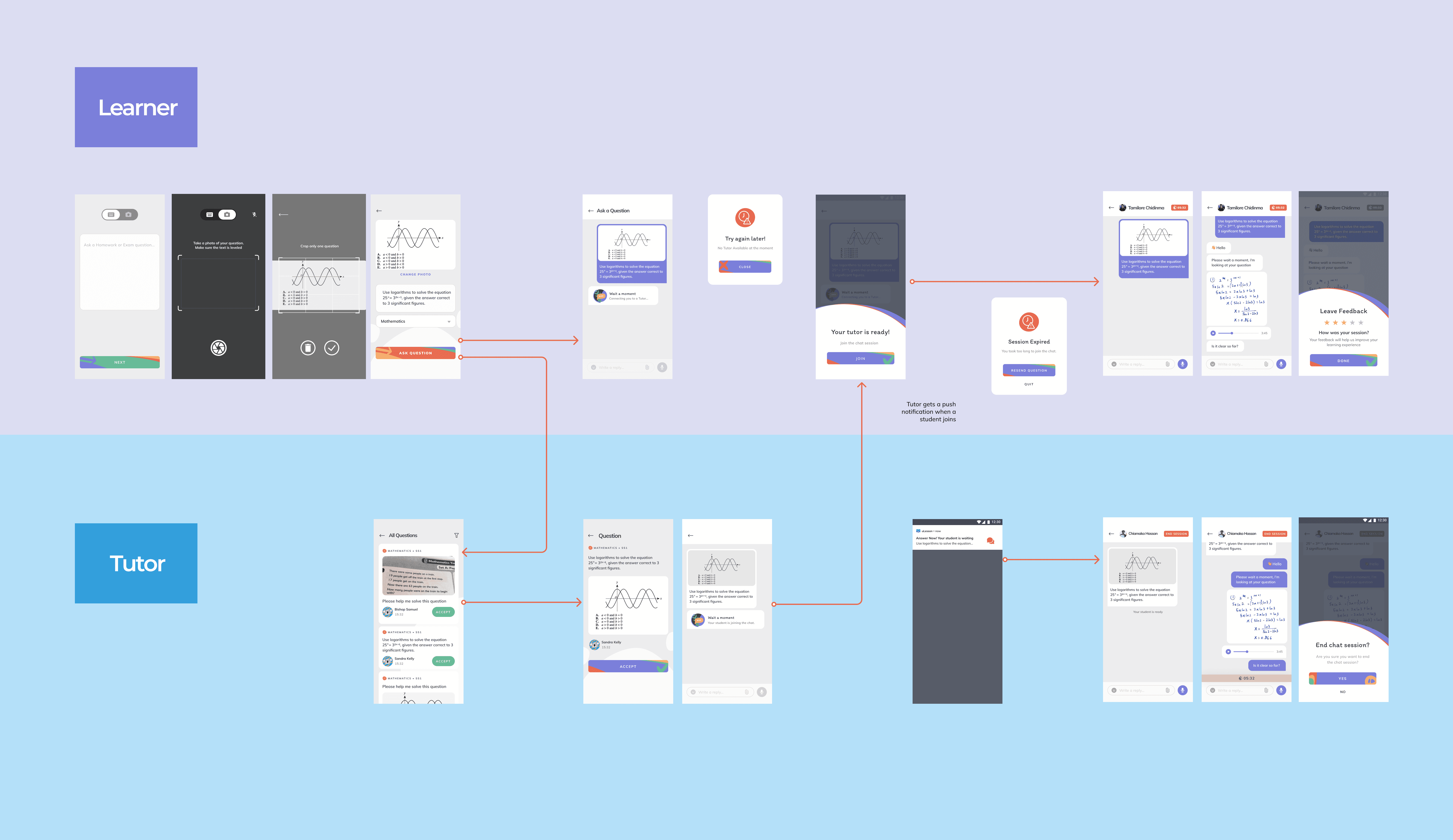
On the learner side, students could submit questions using text or media, start a chat after a tutor accepted the request, see the session duration, and rate the experience afterwards.
On the tutor side, unanswered questions appeared in a shared feed filtered by the subjects they taught. Tutors could accept questions, manage active sessions, send files and lesson links, track ratings and see their earnings.
I owned both the learner and tutor experiences. This case study follows the learner side.
The design question
How might we give learners access to real help without pulling them out of the learning experience?
The first version prioritized immediacy. Chat with a Tutor sat directly on the uLesson home screen, giving learners a quick way into the service.

By the end of 2021, learners had asked 11,184 questions, 11,002 had been answered, and the service had grown to 125 tutors.
Once people started using it, a different problem surfaced
By 2022, the question was no longer whether learners wanted access to tutors. They did. The question became whether we had made asking for help easy enough.
As part of a broader refactor, I ran usability testing on the learner experience. Students could find Homework Help and begin entering a question, but completing the task was less straightforward.
In the study, learners took an average of about 1 minute 10 seconds to submit a homework question. Only 29% completed the task quickly and cleanly; 71% eventually succeeded but made mistakes or had to backtrack along the way.
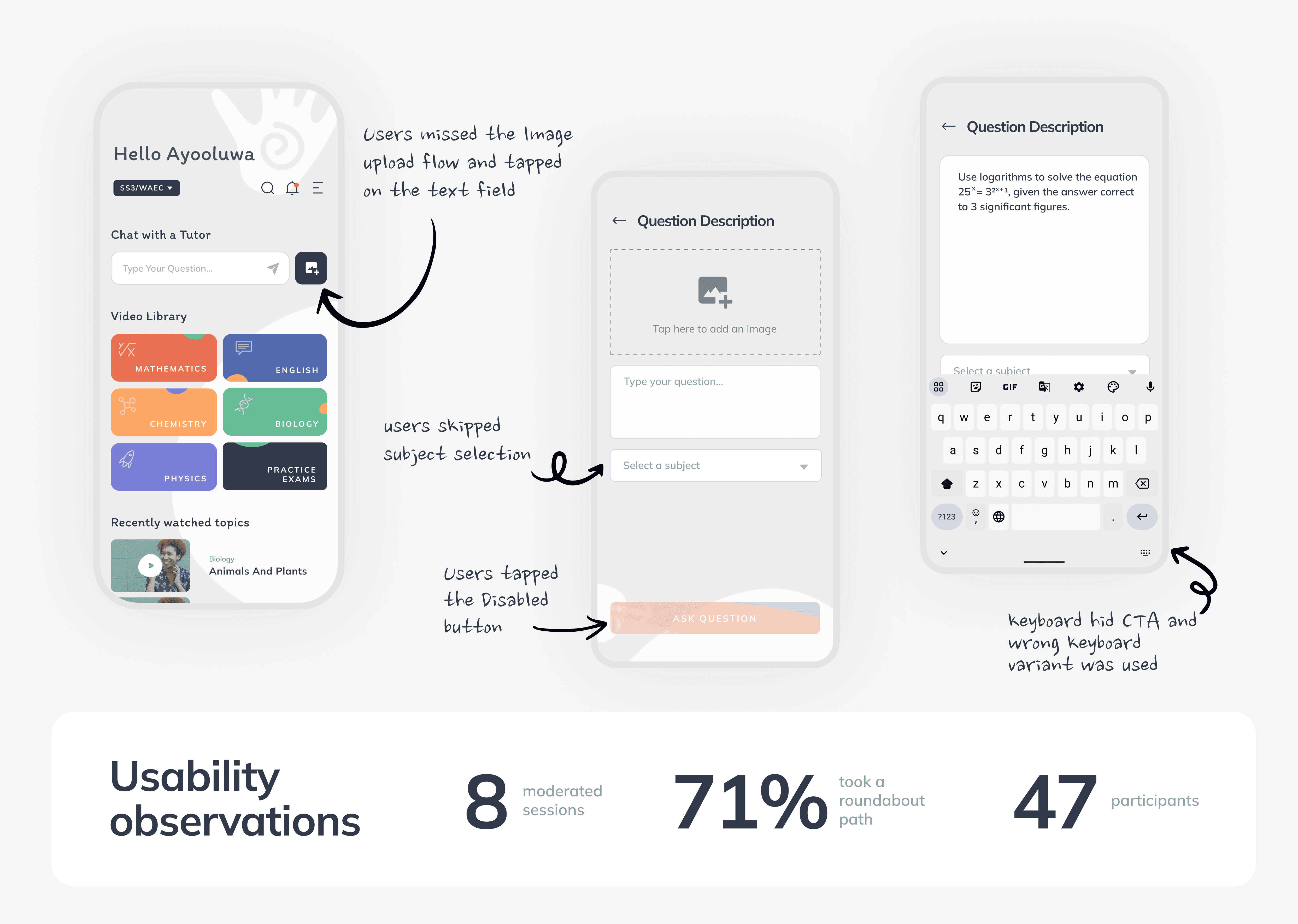
The friction appeared after learners had already typed their question.
Some expected the keyboard's Enter key to submit it. Others couldn't see the next action because the keyboard obscured it. The flow also required learners to select a subject before continuing, but that requirement wasn't obvious enough.
According to an observer,
"The step after typing in your question on the homework help feature caused the users I observed to pause and sometimes stumble before figuring out what to do next".
We stopped treating tutoring like an input field
The June 2022 redesign went beyond a visual refresh. We repositioned the original 1:1 chat experience as Homework Help, then reworked the chat home, question flow, and how the feature was surfaced across the wider uLesson dashboard.
One issue we wanted to solve was the low discoverability of image uploads. Instead of dropping learners straight into a large text field, I made the two ways to ask a question explicit:
Type your question: Learners could still type out a question, but it was now presented as one clear way to start rather than the default experience.
Take a picture: Uploading an image became a first-class action instead of something learners had to discover inside the question field. This made it immediately obvious that they could simply photograph their homework and ask for help.
This made it immediately clear that learners could either type out a problem or simply photograph it.
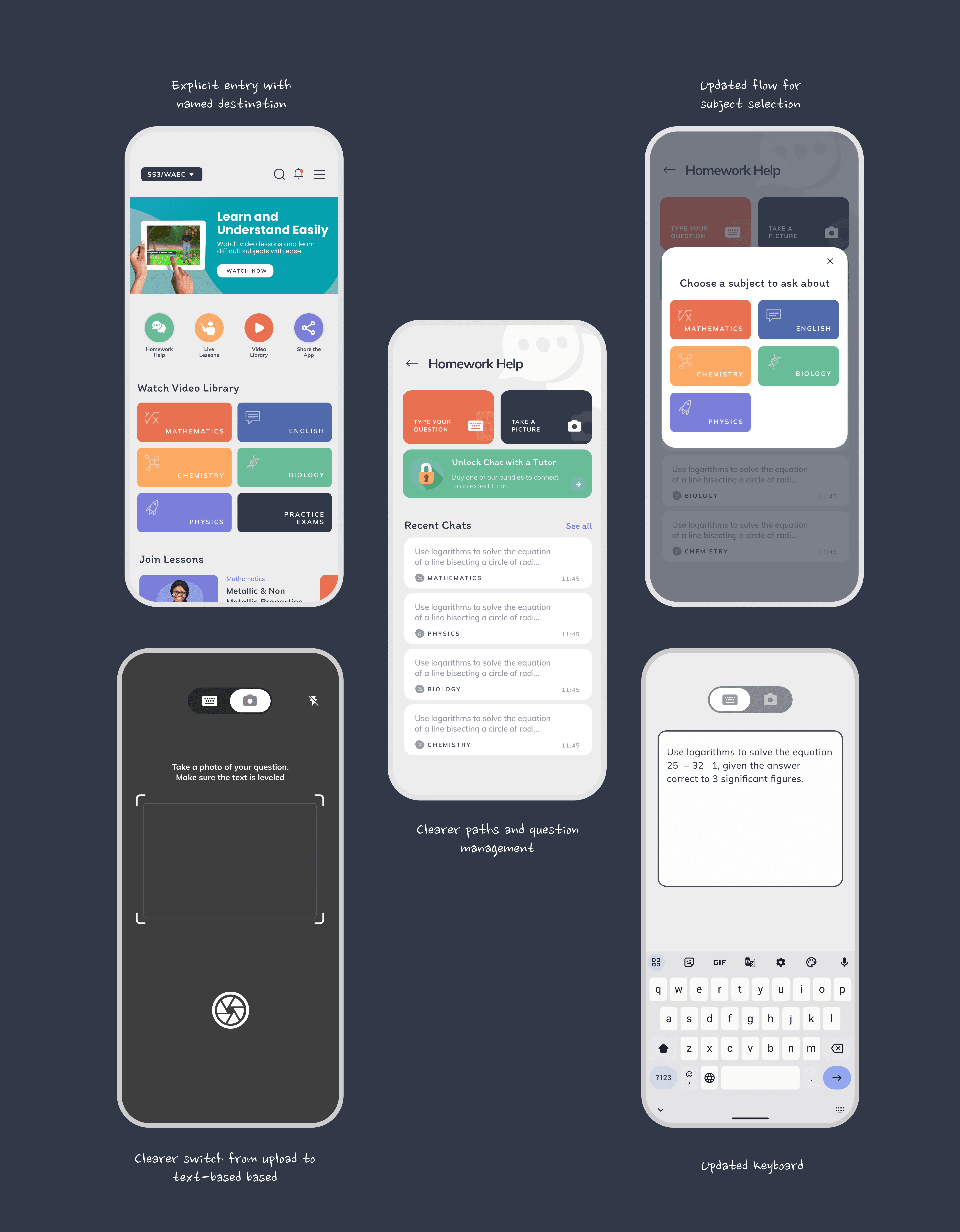
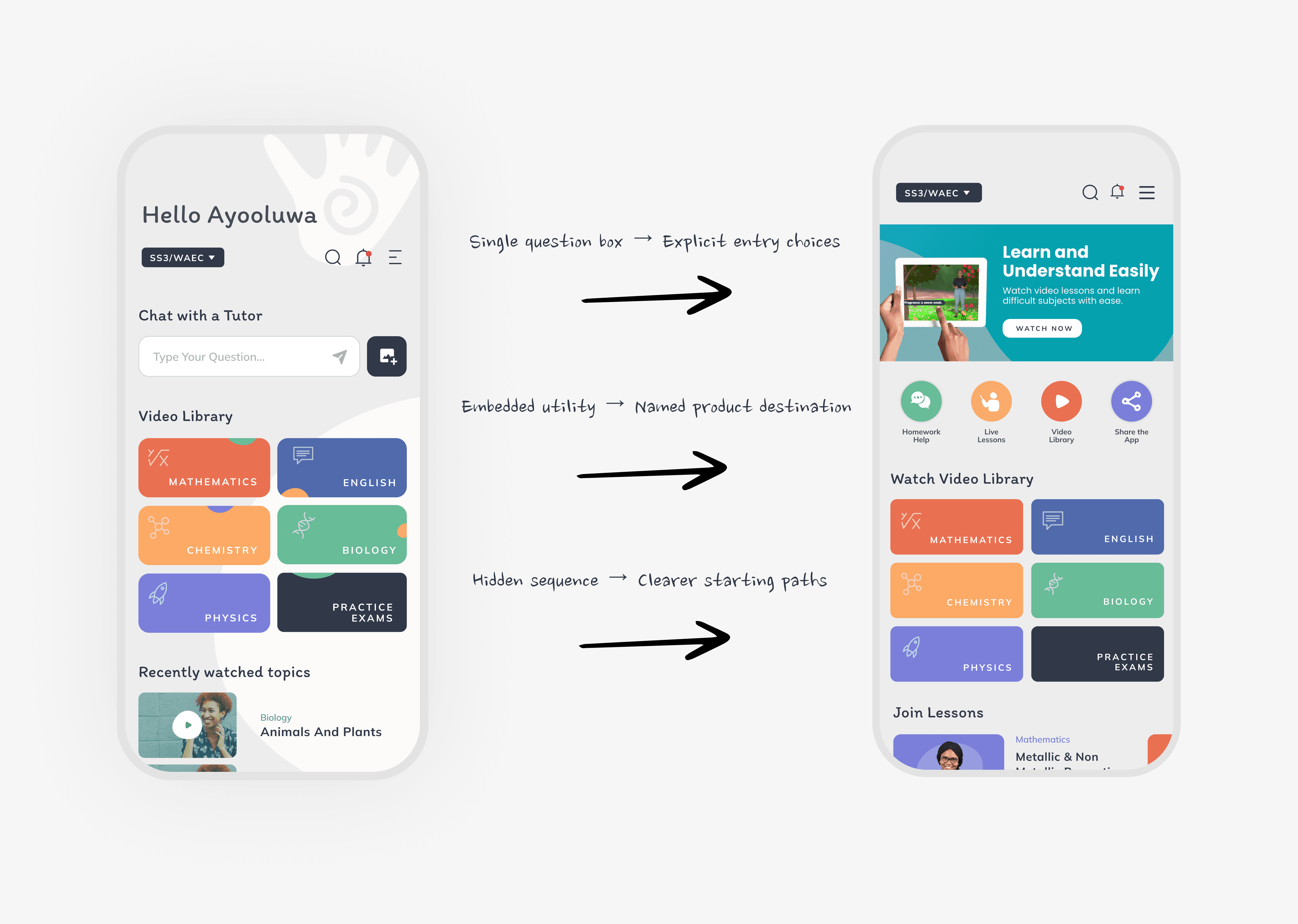
We also gave Homework Help a clearer destination within the main uLesson experience, rather than presenting it as a generic question box.
That shift was important. We stopped treating tutoring as an input field and started treating Homework Help as a product in its own right. The new structure made it clearer what the feature was for, how to get started, and what options learners had before beginning a question.
The product was becoming something learners returned to
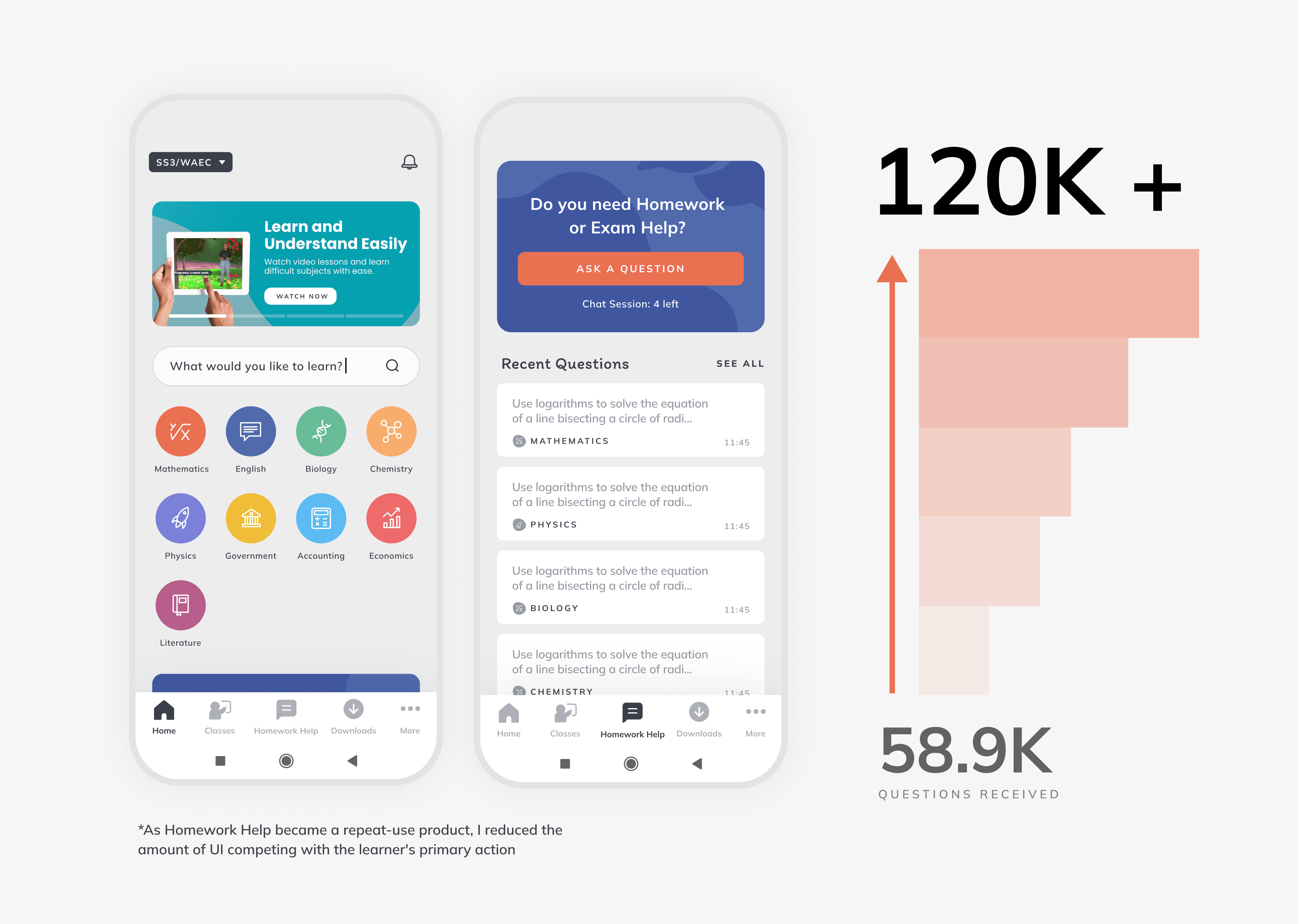
By early 2023, the uLesson app had grown to house more features, and the overall experience needed a refresh. Homework Help was redesigned as part of that wider update, with a cleaner, more modern interface and less visual clutter.
At this point, the product didn't need to explain every capability at once.The design had shifted from helping someone understand a new feature to helping a returning learner get back to what they came for.
The experience became much more focused:
a primary destination (on the bottom nav);
one dominant Ask a Question action;
session availability still visible, but secondary;
Usage was also growing considerably during this period. Homework Help received 58,868 questions in 2022 and 120,177 in 2023. Average session ratings increased from 4.19 in the earlier 2022 data to 4.40 by Q4 2023.
I treat those numbers as evidence of the product's growing use—not as proof that the redesign alone caused the increase.
Growth changed the problem
The original product worked. That became the problem.
Homework Help was solving a real need, but every question still depended on a tutor being available to pick it up, respond quickly, and complete the session.
As usage grew, that dependency became harder to ignore. We were handling roughly 10,000 questions a month, and every additional question meant more tutor workload, more waiting for learners, and more cost to serve.
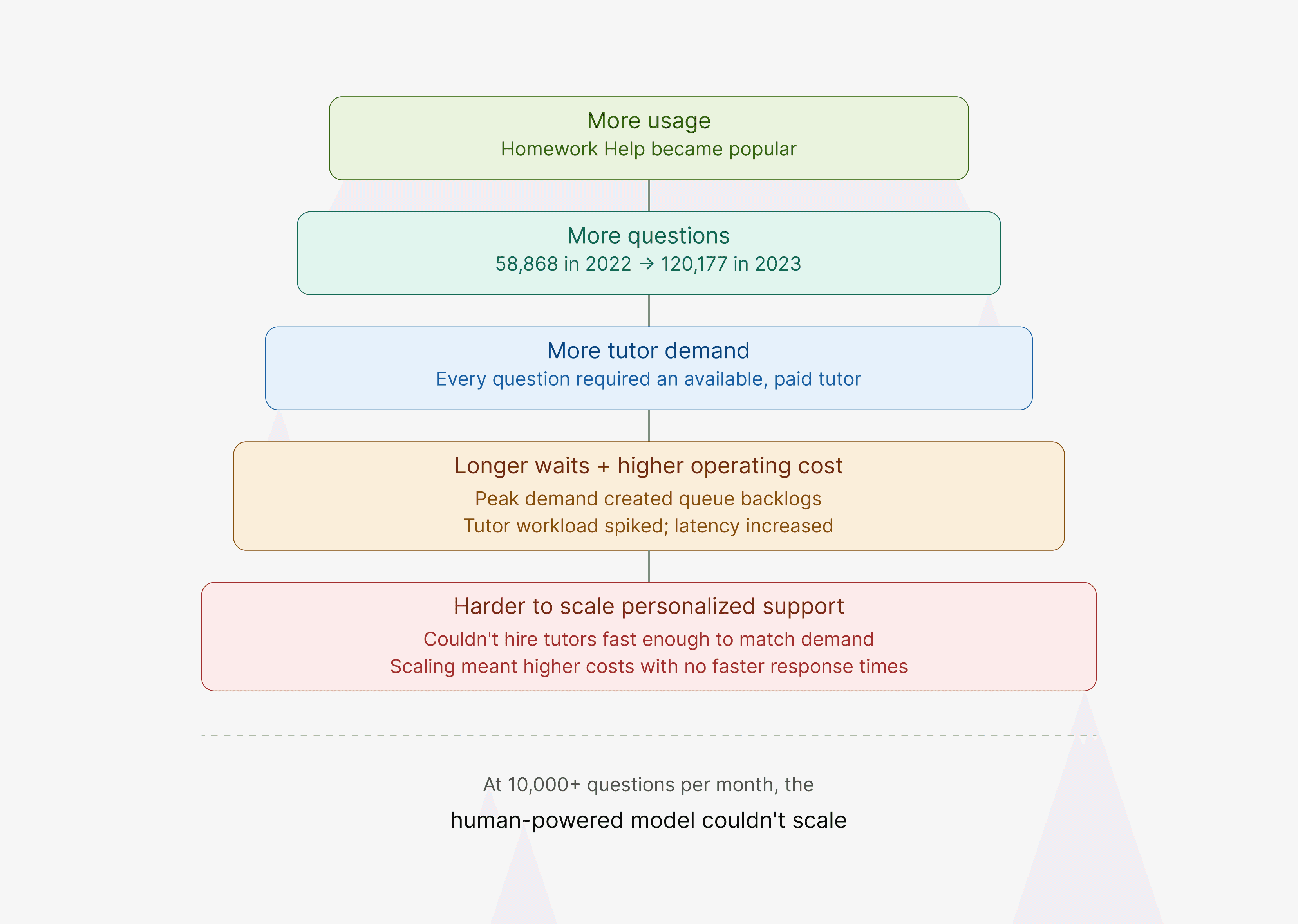
At that point, the problem was no longer just about improving the Homework Help experience. The bigger question became:
How do we keep personalized support fast and useful when the human-powered model becomes harder to scale?
The existing flow made that constraint visible. A learner asked a question, it entered a queue, they waited for an available tutor, the tutor accepted it, and only then could the timed session begin. The experience worked, but the more it was used, the more its limits showed.
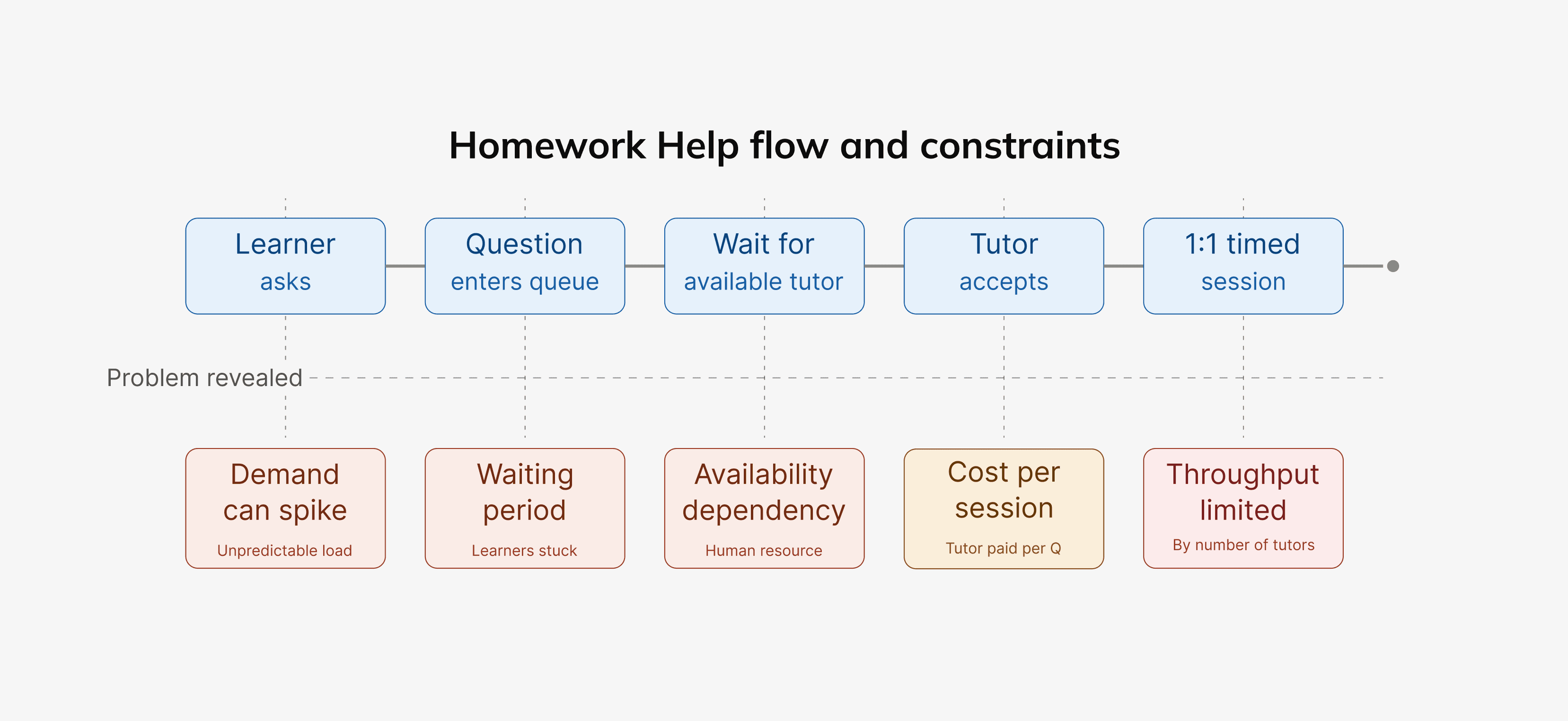
For learners, that meant waiting at the exact moment they were stuck. For the business, every increase in usage also increased the cost and operational load of delivering support.
That pushed us to look beyond another redesign of Homework Help. We needed to rethink the model itself.
What if the learner didn't have to wait?
We started exploring whether AI could provide useful support immediately, without requiring a tutor to be available for every question.
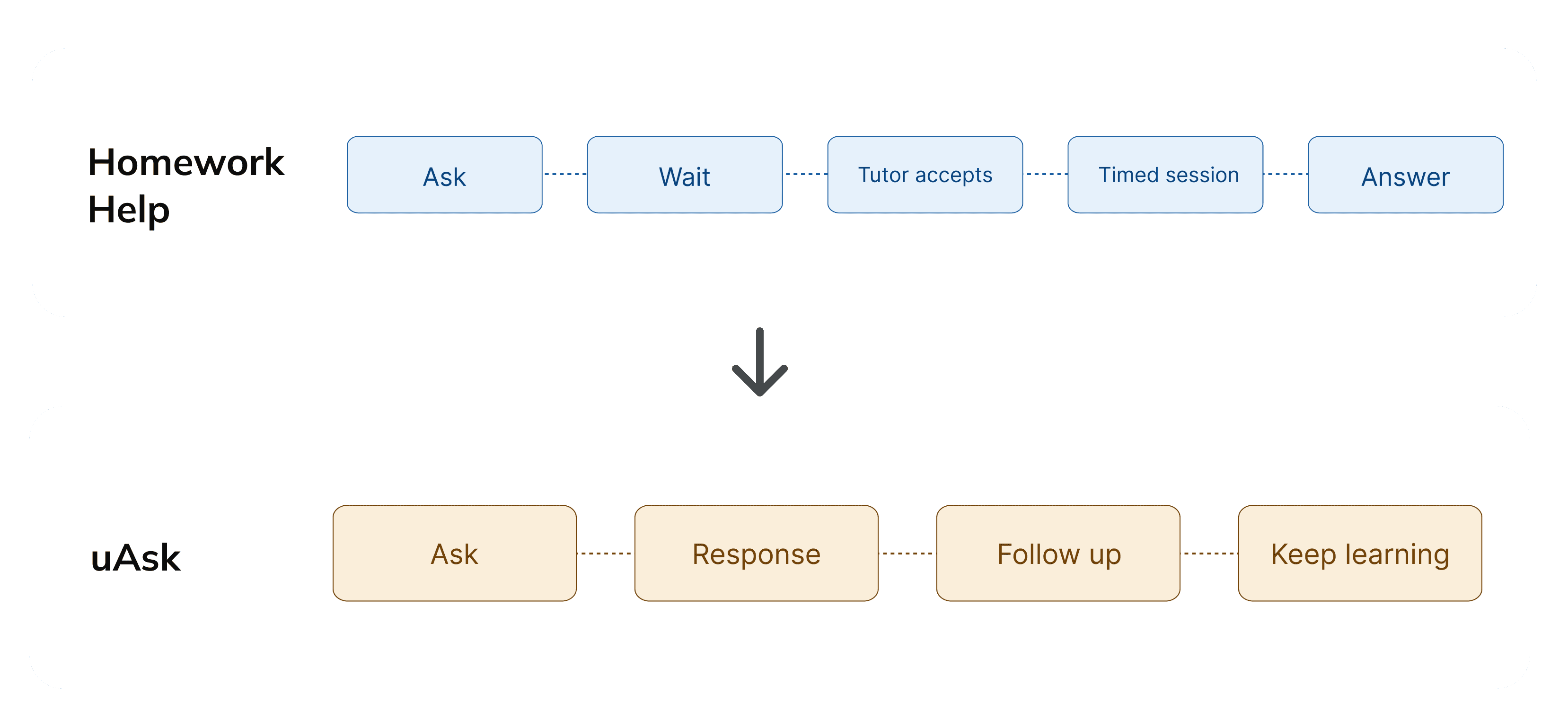
uAsk first launched as a separate app for uLesson premium learners. That gave us room to test a very different support model before integrating it more deeply into the core uLesson experience.
I designed the UX/UI and new interaction flow.
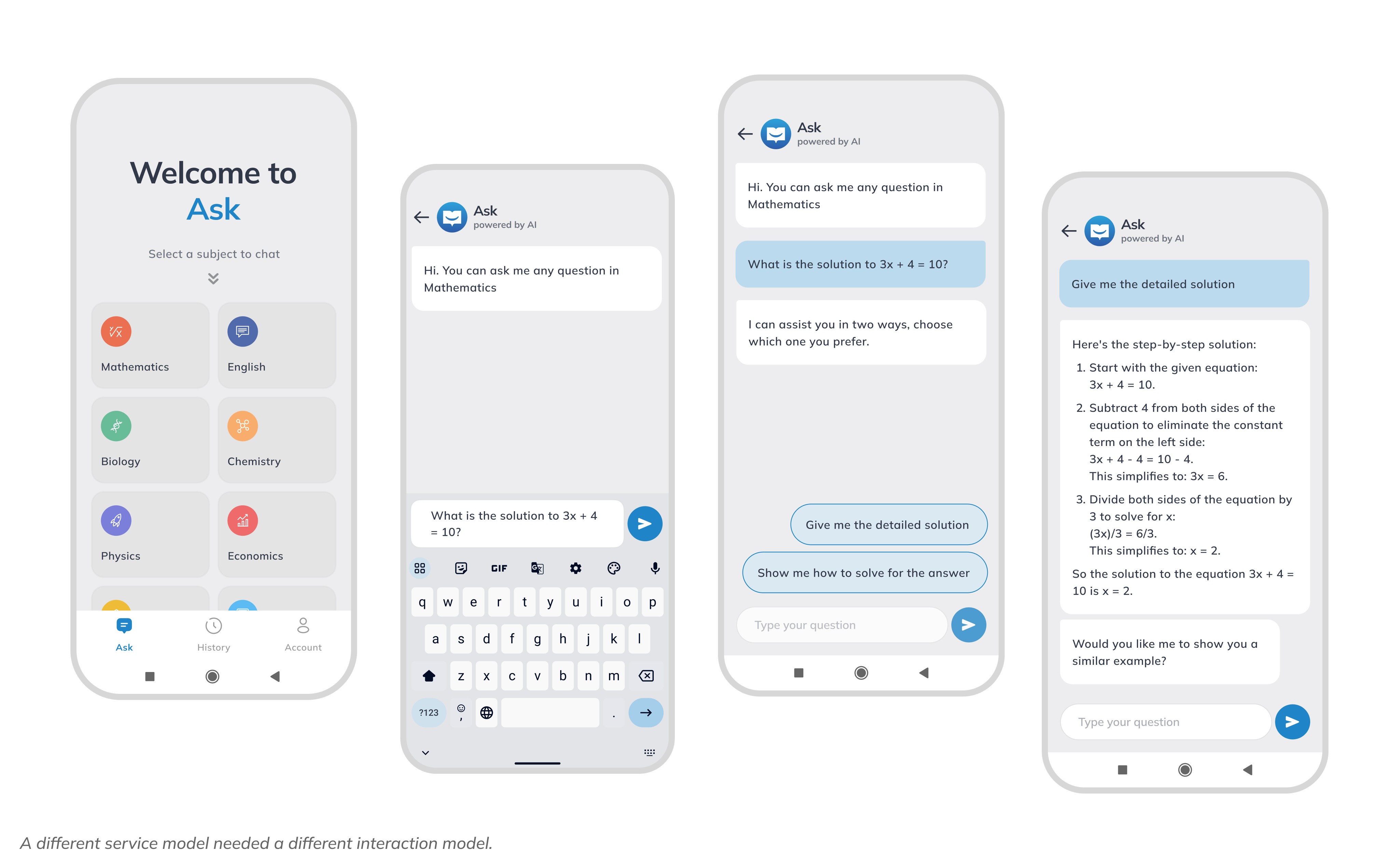
Rather than recreating Homework Help with a bot on the other side, I reconsidered which parts of the old experience only existed because a human tutor was delivering the service.
Tutor matching, availability, queues, session acceptance and timed sessions no longer needed to sit between a learner and the help they needed.
Designing the AI experience
Moving from human tutoring to AI introduced a new set of design questions. It wasn’t enough to make answers faster; uAsk still had to behave like a learning product.
Give the conversation useful context
I kept subject selection lightweight and upfront. It helped orient the learner while giving the experience context before the conversation began. We also constrained responses around the learner’s subject and class level, rather than allowing the assistant to behave like a completely open-ended chatbot.
Guide, don’t just answer
The goal wasn’t simply to shorten the time to an answer. Learners still needed to understand the problem. Rather than assume everyone wanted the same level of support, I designed the conversation so learners could move from guidance to a more detailed explanation and continue asking follow-up questions.Let learners ask with more than text
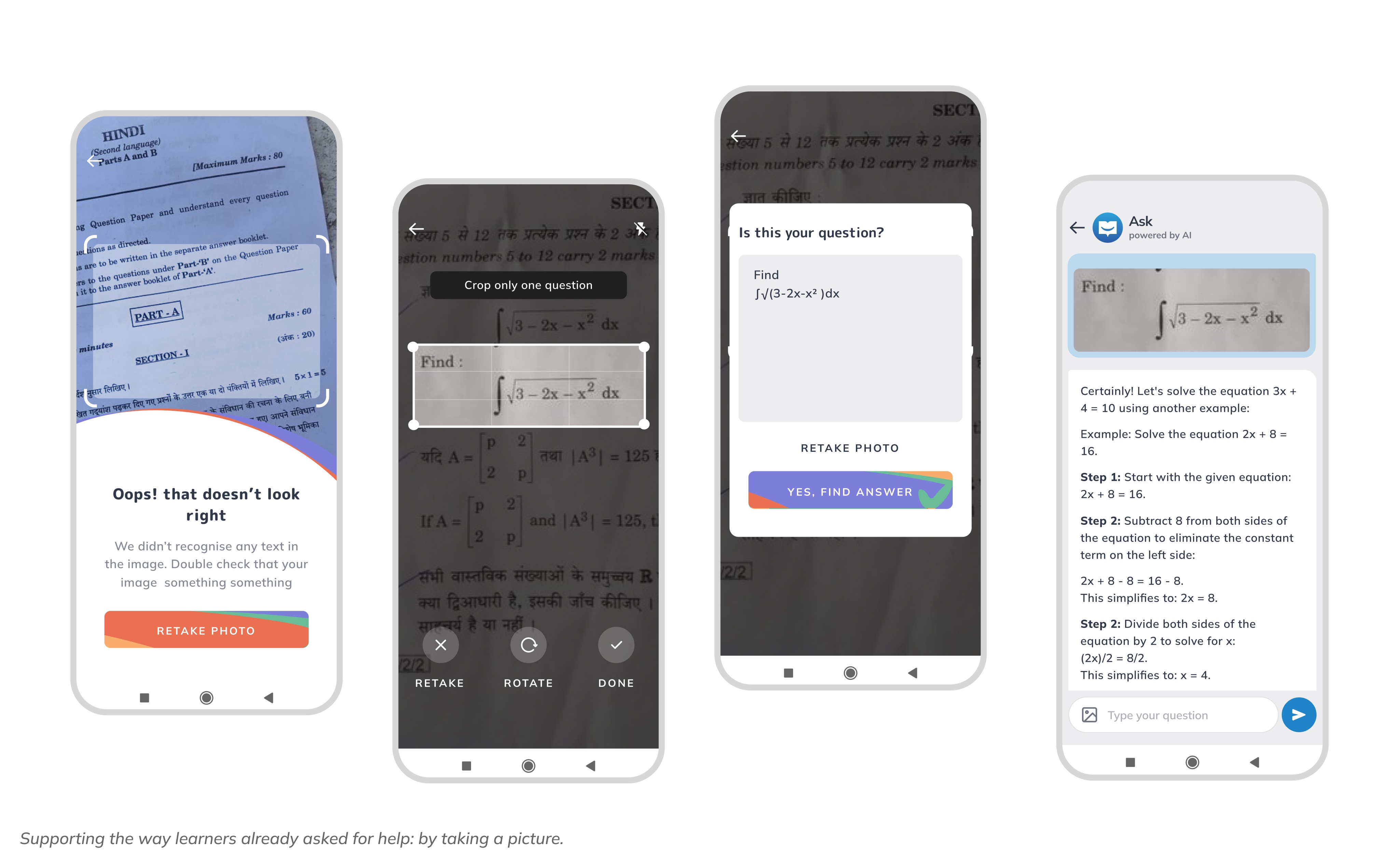
A lot of homework (particularly maths and science) is easier to photograph than type. We supported image/question uploads and used OCR to extract the question so it could move through the AI flow.
Make AI latency visible
Removing the human queue didn’t remove waiting completely. AI introduced a different kind of latency while a response was being generated. I designed response states that made it clear the system was still working rather than leaving learners wondering whether their question had failed.Make conversations something learners could return to
Homework Help had been organized around individual tutor sessions. uAsk needed a different mental model: conversations that learners could return to, continue and deepen over time. That made history part of the core experience rather than simply a record of completed support sessions.

Designing for when AI gets it wrong
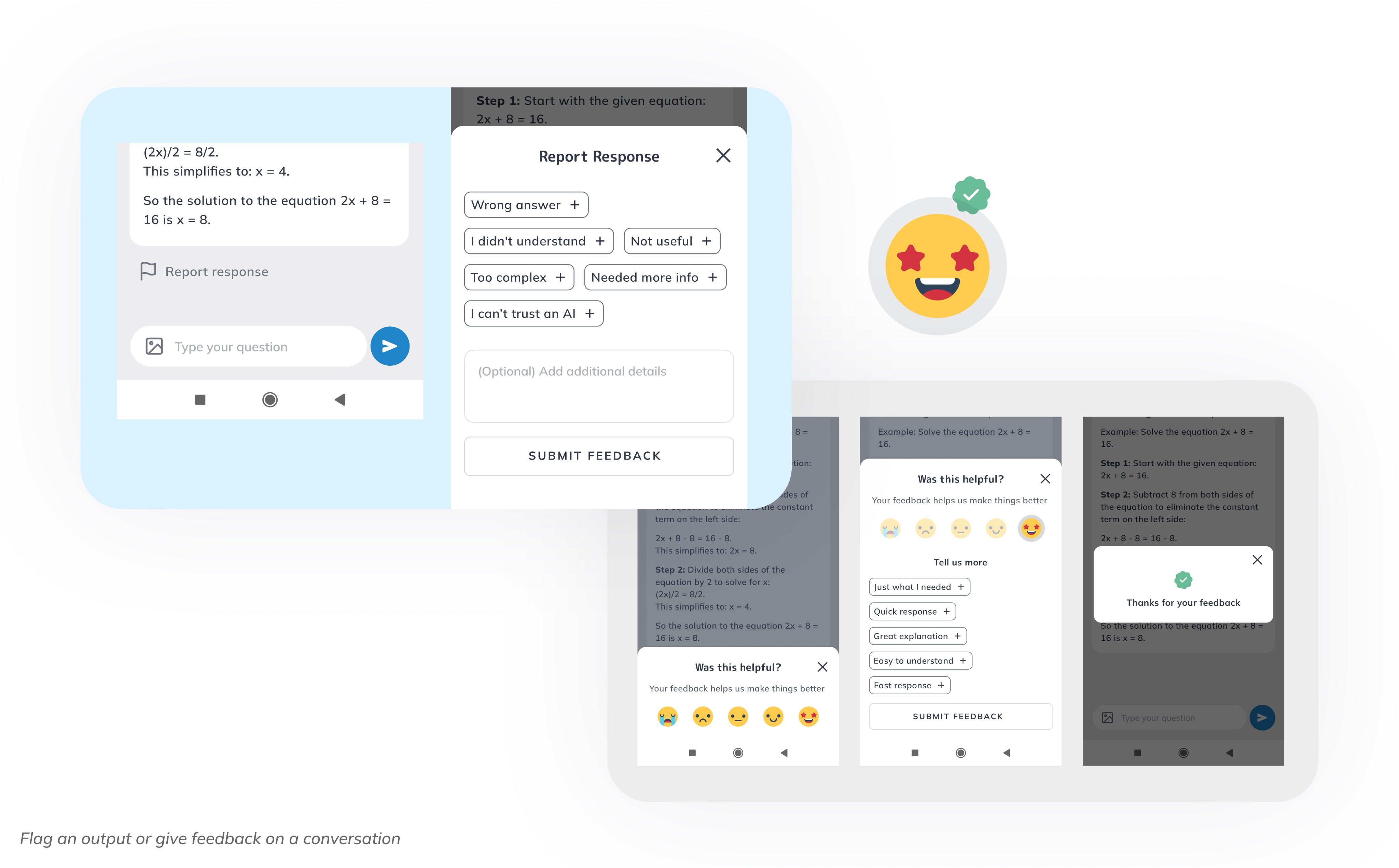
AI responses weren’t always going to be useful, correct or appropriate, so failure had to be part of the product design rather than an edge case.Fall back to a human
AI was not expected to handle every question. When the system couldn’t provide useful help, we could route the learner back to a live tutor rather than leaving them at a dead end.
This meant the transition to AI didn’t require throwing away one of the strongest parts of the original product: access to a real person when needed.
Safety mattered more because our learners were young
uLesson served children and teenagers, so an unrestricted conversational assistant wasn’t appropriate. We introduced safeguards including flagged/restricted words and constrained the assistant around the learner’s subject and educational level. The early uAsk report also recorded 44 profanity blocks, showing that inappropriate inputs were something the system encountered in real use.
We didn’t replace Homework Help overnight
uAsk and Homework Help existed alongside each other for a period while we learned whether AI could become a useful alternative to human tutoring.
Generative AI was still new territory for us, so we treated uAsk as an experiment rather than assuming learners would immediately understand or trust the model.
The two experiences were eventually brought together as the team moved further toward AI-assisted learner support.
Early signals
TThe first uAsk release was a soft launch, reaching 496 unique learners from an addressable group of 5,500 with learners sending an average of 5.2 messages per session.
The clearest early difference was speed.
Homework Help ~7m 23s before a question was accepted
uAsk ~32s
The early report estimated that uAsk reduced the average cost per session by about 97% compared with Homework Help.
I don’t have reliable later-stage performance data, so I treat these as early signals rather than final product outcomes.
Looking back
Over four years, Homework Help taught me something that shaped how I think about product work: a successful feature can outgrow the problem it was built to solve.
In 2021, the problem was access, learners needed help and had nowhere to turn. We solved that. By 2023, we'd created something popular enough that it revealed a different problem entirely. The human-powered model wasn't broken. It was working exactly as designed. But working wasn't the same as scaling.
The hardest part wasn't designing better interfaces. It was recognizing that a problem I'd spent two years refining had become the constraint itself. That recognition pushed us toward something fundamentally different. Not a better version of Homework Help, but a different approach to the same need.
We didn't defend the original solution because we'd built it. We asked whether the model could still work at scale, and when the answer was no, we were willing to change. That's the work I'm most proud of not just the pixels, but the judgment to know when to stop optimizing and start over.